Plan your visit to Transfagarasan
Transfagarasan is a 90km mountain road best known for its hairpin turns, high-altitude views, and the climb to Bâlea Lake at 2,042m. This is not a quick roadside stop because even a well-planned visit usually turns into a full-day outing once you factor in scenic pull-offs, traffic, and weather on the ridge. The biggest difference between a great day and a frustrating one is timing: late-morning summer traffic can slow the best stretches to a crawl. This guide covers route choices, timing, transport, and what to prioritize.
Quick overview: Transfagarasan at a glance
If you’re deciding whether to self-drive or book a day tour, this is the part that changes the day most.
- When to visit: Usually late June–October, with daylight driving the safest option; weekday mornings in September are noticeably calmer than late mornings on Jul–Aug weekends, because traffic bunches up around Bâlea Lake and the main photo pull-offs.
- Getting in: From €0 for self-driving the public road. Guided day tours from about €109. You can leave it late in shoulder season, but Jul–Aug weekends are worth booking 3–7 days ahead if you want a tour seat from Sibiu, Brasov, or Bucharest.
- How long to allow: 8–12 hours for most visitors. Poienari Fortress, long photo stops, and traffic near the summit push it to the longer end.
- What most people miss: The classic panorama is not the lake parking lot itself, and Vidraru Dam deserves more than a 5-minute stop if you want the full scale of the route.
- Is a guide worth it? Yes if you don’t want to drive hairpins for hours or manage weather, closures, and stop timing yourself. No, If you’re comfortable self-driving, and don’t need one for the road itself.
🎟️ Day-trip seats for Transfagarasan usually fill 3–7 days in advance during July and August. Lock in your visit before the date you want is gone.
See ticket options
Jump to what you need
🕒 Where and when to go
🗓️ How much time do you need?
🎟️ Which ticket is right for you?
🗺️ Getting around
🛣️ Road highlights
♿ Facilities and accessibility
Where and when to go
How do you get to Transfagarasan?
The road runs through the Făgăraș Mountains between the northern gateway near Cârțișoara and the southern approach near Curtea de Argeș, so the easiest access depends on which city you’re starting from.
Address: DN7C Transfagarasan, between Cârțișoara and Curtea de Argeș, Romania
- Car: Northern access via Cârțișoara is the simplest approach from Sibiu, while Curtea de Argeș makes more sense from Bucharest.
- Guided tour transfer: Hotel pickup from Sibiu, Brașov, or Bucharest is the easiest option if you don’t want to handle mountain driving and summer congestion.
- Public transit: There is no practical through-route public transport for the full road, so most visitors either self-drive or join a day tour.
- Taxi / rideshare: Useful only to reach gateway towns, not for a full crossing with scenic stops.
Getting here from nearby cities
Visitors reach Transfagarasan from several cities, but Sibiu, Brașov, and Bucharest are the bases that make the most logistical sense.
From Sibiu
- Distance: About 48km to the northern gateway near Cârțișoara
- Travel time: Around 1–1.5 hours by car or guided tour transfer
- Time to budget: Leaves you with the fullest day on the road and the least dead commute
From Brașov
- Distance: About 105km to the northern gateway near Cârțișoara
- Travel time: Around 2–2.5 hours by car or guided tour transfer
- Time to budget: Works as a long day trip, but you’ll want an early start for full-route stops
From Bucharest
- Distance: About 200km to the southern start near Curtea de Argeș
- Travel time: Around 3 hours to the start by car or tour vehicle
- Time to budget: This is a true full-day outing, and shorter stops are what usually get cut first
Which entrance should you use?
There isn’t a single gate — there are two main road approaches, and most visitors get the route direction wrong for their base city rather than the road itself.
- Northern approach, Cârțișoara: Best for Sibiu and many Brașov starts. Expect smooth access early, but slower traffic near Bâlea on Jul–Aug weekends.
- Southern approach, Curtea de Argeș: Best for Bucharest starts and for seeing Vidraru Dam first. Expect the heaviest slowdowns closer to the summit late in the morning.
When is Transfagarasan open?
- Late June–October: Full high-mountain route usually opens only in the snow-free season
- November–late June: Upper section closed by snow; lower sections may still be accessible
- Last entry: No formal gate, but a full crossing with stops is only realistic in daylight
When is it busiest? Jul–Aug weekends from late morning to mid-afternoon are the slowest, especially around Bâlea Lake, the tunnel, and the main photo pull-offs.
When should you actually go? A weekday morning in September is the sweet spot because you get open-road views, easier parking, and enough daylight without peak-summer convoy traffic.
How much time do you need?
| Visit type | Route | Duration | Walking distance | What you get |
|---|---|---|---|---|
Highlights only | Cârțișoara → Bâlea Lake panorama → lake stop → return north | 4–5 hours | ~1km | You get the classic summit scenery and the famous road views, but you skip Vidraru Dam, the southern descent, and most of the historical stops. |
Balanced visit | Cârțișoara → Bâlea Lake → tunnel crossing → Vidraru Dam → return or continue south | 8–9 hours | ~2.5km | This adds the full mood shift from alpine ridges to reservoir views and makes the journey feel like a complete day out rather than just a quick photo stop. |
Full exploration | Cârțișoara → Bâlea Lake → southern descent → Vidraru Dam → Poienari area → Curtea de Argeș | 10–12 hours | ~4–5km | You get the complete road story, from summit lake to fortress lore, but it is a long day and Poienari adds real effort if the climb is open. |
Which Transfagarasan ticket is best for you
| Ticket type | What's included | Best for | Price range |
|---|---|---|---|
Self-guided drive | Public road access + your own vehicle + flexible stops | A clear-weather day when you want full control and don’t mind handling route timing, closures, and parking yourself | From €0 |
Transfagarasan Highway Day Tour | Full-day Transfagarasan and Dracula history tour + hotel transfers + expert guide + AC transport with Wi-Fi + optional skip-the-line entry tickets | Travelers who want Romania’s most scenic mountain drive, medieval history, and Vlad the Impaler legends combined in one easy full-day trip from Bucharest | From €109 |
How do you get around Transfagarasan?
Road layout and suggested route
This is best explored by car or tour vehicle over a full day, and the route is large enough that choosing your direction matters almost as much as choosing your stops.
The northern climb from Cartisoara reaches the alpine section faster, while the southern approach from Curtea de Arges gives you Vidraru Dam and Poienari earlier in the day.
- Northern ascent: Cartisoara gateway → fastest route to the classic hairpins and summit views → budget 2–3 hours with stops.
- Balea summit zone: Lake, tunnel, and main panorama points → the most photogenic section of the road → budget 1–2 hours.
- Southern descent: Vidraru Dam, forested bends, and Poienari area → the most varied stretch after the summit → budget 3–4 hours.
Suggested route: Start early from the side closest to your base city, do the summit viewpoints before late-morning traffic, then save longer stops like Vidraru or Poienari for later. Most people lose time by lingering at the first easy photo stop and rushing the dam or southern side.
Maps and navigation tools
- Map: Download an offline road map before arrival → it should cover Carțisoara, Balea Lake, Vidraru Dam, and Curtea de Arges → get it onto your phone before leaving the city.
- Signage: Through-driving is straightforward, but scenic pull-offs and viewpoint timing are less obvious than the route itself.
- Audio guide/app: There is no standard route-wide audio guide experience, so live guiding adds more value than an app if you want history and stop planning.
- Large outdoor POI: A guided option is meaningfully easier if you don’t want to track closures, parking, and stop order while driving mountain hairpins.
💡 Pro tip: Don’t judge the whole route by your first pull-off. The postcard view most people want comes near the Balea Tunnel area, not at the earliest roadside stop.
What is Transfagarasan worth visiting for?

The Balea Tunnel panorama
Road feature: Signature high-altitude viewpoint
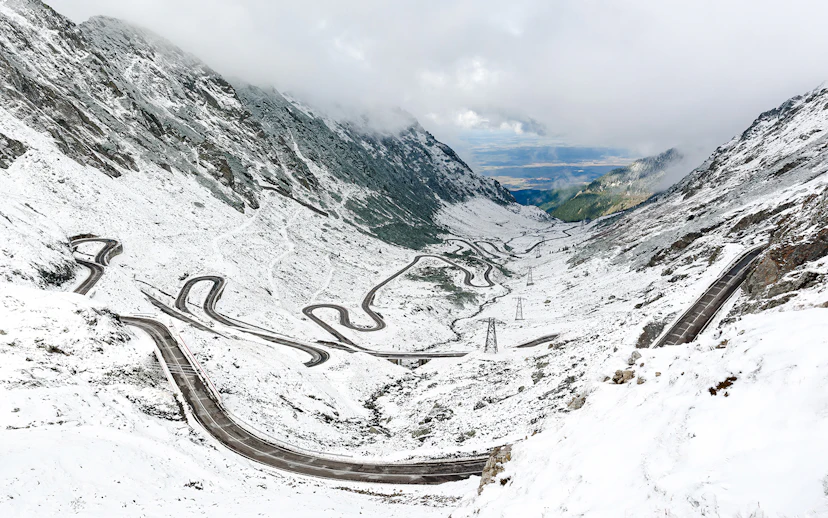
This is the classic postcard angle of the road snaking down the mountain in tight switchbacks. It’s the stop that turns the drive from scenic to unmistakably memorable, especially on a clear day when you can see the whole ribbon of asphalt beneath you. What most visitors miss is that the strongest view is not the lakefront parking area itself, but the pull-offs closer to the tunnel and ridge line.
Where to find it: Near the Balea Tunnel at the summit section of the road
Bâlea Lake
Natural feature: Glacial lake at 2,042m
Balea Lake is the emotional center of the route, a cold alpine basin surrounded by rocky slopes, summer snow patches, and mountain huts. It’s where most visitors stop longest, whether for photos, a short walk, or lunch. What gets rushed is the shoreline itself: many people photograph the lake from the parking area and never walk a few minutes farther for the quieter, more open angles.
Where to find it: At the summit of the road, just beside the Balea Tunnel area
Vidraru Dam
Engineering feature: 166m arched dam and reservoir
Vidraru is the point where the drive shifts from alpine spectacle to big-scale engineering. Standing above the dam, you get a completely different sense of the route, not just as a mountain road, but as a corridor shaped by some of Romania’s boldest infrastructure projects. Most visitors give it a quick photo stop, but the real payoff is walking far enough to take in both the dam wall and the long sweep of the reservoir.
Where to find it: On the southern side of the route, below the highest section
Poienari Fortress
Historic site: Vlad the Impaler’s cliff-top fortress
Poienari is the route’s strongest historical stop and the one that feels most earned. The ruined fortress is tied to Vlad the Impaler, and the climb turns it into more than a roadside check-in. What visitors often underestimate is the effort involved. The 1,480 steps are part of the experience, not just the access route. If the site is open and you have the stamina, the climb adds real texture to the day.
Where to find it: Near the southern approach, above the Argeș Valley
Capra Waterfall
Natural feature: Roadside mountain cascade
Capra Waterfall is one of the best quick stops because it gives you a break from long driving without demanding a full detour. The combination of mist, rock, and pine air makes it feel more immersive than some of the big roadside lookouts. Many travelers treat it as a stretch-your-legs pause, but it’s worth slowing down for the sound and the cooler air after the higher, more exposed summit stops.
Where to find it: Along the upper mountain section near the summit area
Brown bear sightings
Wildlife highlight: Carpathian brown bears
Seeing a bear from a safe distance is one of the most memorable parts of the southern forested stretch. It’s not guaranteed, but it’s common enough that guides actively watch for it in summer. The detail most people miss is that this is best treated as a drive-by wildlife stop. The safest and often best views come from the vehicle, and getting too close is exactly how a memorable stop turns into a risky one.
Where to find it: Most often on the forested southern side of the road
Facilities and accessibility
- 🚻 Restrooms: Basic restrooms are available at major stop areas such as Balea Lake and some roadside chalets, but lines are common in Jul–Aug.
- 🍽️ Roadside food stops: Mountain huts, chalet restaurants, and snack stalls cluster around Balea Lake and key stop areas, with simple hot meals and tourist-area pricing.
- 🛍️ Souvenir stalls: A summer bazaar near Balea Lake sells snacks, magnets, wool goods, and easy road-trip souvenirs.
- 🪑 Seating/rest areas: Chalet terraces, dam viewpoints, and larger pull-offs are your main places to sit and reset between driving stretches.
- 🅿️ Parking: Larger parking areas exist near Balea Lake and Vidraru Dam, but the smallest scenic pull-offs fill fast on summer weekends.
- 🩺 First aid/medical support: This is a spread-out road trip rather than a single staffed venue, so your tour vehicle or car is your practical base between stops.
- ♿ Mobility: The drive itself works well as a seated sightseeing experience, but many viewpoints have uneven ground, sloped pull-offs, and optional climbs such as the 1,480 steps to Poienari Fortress.
- 👁️ Visual impairments: There are no route-wide tactile tools or structured accessibility services, so travelers with low vision usually get more from a guided day trip than from a self-drive visit.
- 🧠 Cognitive and sensory needs: Weekday visits in September are the least overstimulating, while Jul–Aug weekends can feel noisy and crowded around Bâlea Lake because traffic, tour groups, and market stalls all cluster together.
- 👨👩👧 Families and strollers: Flat lakefront and parking areas are manageable, but uneven shoulders, steep viewpoints, and fortress access are not pushchair-friendly end to end.
This works well for children who enjoy scenery, animals, and frequent short stops more than long indoor visits.
- 🕐 Time: A realistic family outing is 6–8 hours with selected stops, and Bâlea Lake plus one southern highlight is usually enough.
- 🏠 Facilities: The easiest family stops are the lake area and larger dam viewpoints, where food, restrooms, and parking are most likely to be available together.
- 💡 Engagement: Turn the drive into a lookout game. Bears, waterfalls, tunnels, dams, and hairpins give children something concrete to watch for.
- 🎒 Logistics: Bring layers, water, and snacks, because the summit feels colder than Sibiu and waiting until the alpine stops for basics can be expensive.
- 📍 After your visit: Sibiu is the easiest family-friendly base afterward, with a compact old town and plenty of relaxed dinner options after a long road day.
Rules and restrictions
What you need to know before you go
- Entry requirement: The road itself is free, but guided day tours require an advance booking and an early pickup window.
- Bag policy: There is no formal bag check, so keep luggage to a day bag that fits easily in your car or tour vehicle.
- Re-entry policy: There is no single exit gate, but turning back mid-route can cost 1–2 extra hours once summit traffic builds.
Not allowed
- 🚫 Food and drink: Eating at stops is fine, but leaving trash at viewpoints or near wildlife areas is not.
- 🚬 Smoking/vaping: Avoid smoking in forested pull-offs during dry summer conditions and use designated rest-stop areas where available.
- 🐾 Pets: Pets are manageable on self-drive trips, but guided tours set their own rules and wildlife areas are not suitable for roadside roaming.
- 🖐️ Wildlife interaction: Never feed or approach bears, even if they seem used to cars.
Photography
Handheld photography is one of the main reasons to come, and it’s generally fine at viewpoints, dam stops, and the lake area. The real rule is about where you stop: don’t pull over on blind bends or narrow shoulders just for a quick shot. Flash is irrelevant outdoors, but tripods and selfie sticks only make sense where they won’t block traffic, parking flow, or other visitors.
Good to know
- Seasonality: The high road usually opens only from late June to October, so a sunny city forecast does not guarantee the summit section is open.
- Traffic pattern: A stop that takes 10 minutes on a weekday can easily turn into an hour near Bâlea Lake on an August weekend.
Practical tips
- Booking and arrival: Book 3–7 days ahead for Jul–Aug weekends if you want a guided day trip from Sibiu, Brașov, or Bucharest, and be ready 10–15 minutes before pickup because mountain-road days start early for a reason.
- Pacing: Don’t burn all your time at the first summit stop. Save energy for Vidraru Dam and, if it’s open, Poienari, because those are the parts most rushed at the end of a long day.
- Crowd management: If you can choose, go on a weekday in September; you’ll usually get the same views as August with less stop-start traffic near the tunnel and easier parking at Bâlea.
- What to bring or leave behind: Bring layers even in summer because 2,042m feels colder than Sibiu, and carry some Romanian leu for food stops, bathrooms, and the 100 RON cable car if you use it.
- Food and drink: Eat either before the climb or as a proper stop at Bâlea or Vidraru. Relying on random snack stalls late in the day usually means higher prices and fewer good options.
- Driving mindset: This is a scenic mountain day, not a fast road test, so build in extra time for slow vehicles, viewpoint queues, and safe wildlife stops.
What else is worth visiting nearby?
Commonly paired
Poienari Fortress
Distance: On the southern side of the route, near the Vidraru section
Why people combine them: It adds the strongest historical stop to a day otherwise dominated by scenery, and the Vlad the Impaler connection gives the road some real narrative weight.
Commonly paired
Curtea de Argeș Monastery
Distance: At the southern gateway area of the route
Why people combine them: It is an easy pre- or post-road cultural stop, and it balances a long mountain drive with one of Romania’s most striking monastery visits.
Also nearby
Vidraru Dam
Distance: Directly on the southern route section
Worth knowing: This is not just a drive-by engineering stop — if you have time, it is one of the clearest places to understand the scale of the whole journey.
Carta Abbey
Distance: Often combined from the northern side on Sibiu- or Brașov-based itineraries
Worth knowing: It works best as a calmer architectural contrast before or after the road, especially if you want something less exposed and weather-dependent.
Eat, shop and stay near Transfagarasan
- On-site: Bâlea Lake chalets and roadside food stops serve soups, grilled trout, simple Romanian dishes, and hot drinks at convenience-first prices.
- Bâlea Lake chalet restaurants (0–5 min walk, summit area): The easiest place to get a hot meal without leaving the route, and the best choice if weather turns cold fast.
- Roadside eateries near the Vidraru section (short stop, southern side): Better for a proper sit-down meal once you’ve cleared the busiest summit stretch.
- Rustic chalets on the route (varies by itinerary): Worth it for trout, local cheese, and a real break from continuous driving rather than another snack stop.
- 💡 Pro tip: Eat either before the midday summit rush or after it. Late lunch around Bâlea on an August weekend means longer waits and fewer good tables.
- Bâlea Lake summer bazaar: Souvenirs, snacks, knitwear, and easy take-home gifts right by the summit stop.
- Roadside souvenir stalls: Small seasonal stands along major pull-offs are useful for quick purchases, but the best concentration is still around Bâlea.
If you’re basing yourself in Sibiu, yes. It’s the cleanest and easiest launch point for the northern approach and makes the road feel like a day trip rather than a dawn-to-dark expedition. Curtea de Argeș works if you want a southern start, but most travelers won’t want to stay there over Sibiu unless they’re building a longer south-to-north route. Brașov is workable, but the day is longer and more driving-heavy.
- Price point: Sibiu gives you the broadest hotel range, from budget guesthouses to comfortable mid-range stays, without peak-mountain pricing.
- Best for: Short stays where you want a simple early start, easy dinner afterward, and a strong city base if the weather shifts.
- Consider instead: Brașov if you’re combining the road with Bran Castle or other eastern Transylvania stops, or Curtea de Argeș if you specifically want the southern ascent without returning north.
Frequently asked questions about visiting Transfagarasan
Most visits take 8–12 hours if you want the road to feel like a full day rather than a quick summit photo stop. A shorter 4–5 hour outing works if you only drive to Bâlea Lake and back from the northern side, but Vidraru Dam, the southern descent, and Poienari are the parts most often lost when time gets cut.
No ticket is needed to drive the road itself, but guided day tours are worth booking 3–7 days ahead in July and August. Outside peak summer, last-minute space is more common, especially from Sibiu and Brașov, but weather and limited vehicle capacity still make some planning worthwhile.
If you’re on a tour, aim to be ready 10–15 minutes before pickup. If you’re self-driving, an 8am start is usually the difference between a flowing road and late-morning traffic around Bâlea Lake, especially on summer weekends when the photo pull-offs start filling early.
Yes, a small backpack is the most practical option for this route. There is no formal bag check on the road, but you’ll want to keep it light enough for easy in-and-out stops, and large luggage is awkward in small tour vans or when parking spaces are tight at the summit.
Yes, photography is one of the main reasons people come. The important rule is where you stop, not whether you shoot: use proper pull-offs, viewpoints, and parking areas rather than narrow shoulders or blind bends, because the road is active and summer traffic can be constant around the most famous photo points.
Yes, it works well as a small-group or private day trip. In fact, many visitors prefer going with a guide because the long driving hours, closure checks, and stop timing are easier to manage when someone else is handling the route and you can focus on the scenery.
Yes, as long as you plan it as a stop-based scenic day rather than a non-stop road crossing. Children usually enjoy the hairpins, tunnel, lake, dam, and possible bear sightings, but a selective 6–8 hour version is more realistic than a full 12-hour route with every optional stop.
Partly, but not fully. The drive itself works well as seated sightseeing, and some major viewpoints are reached straight from parking areas, but many pull-offs have uneven surfaces and Poienari Fortress is inaccessible for most mobility needs because of the 1,480-step climb.
Yes, but options are clustered rather than evenly spread along the road. Bâlea Lake has the best concentration of chalets, stalls, and hot food, while the Vidraru side has useful meal stops lower down; bringing snacks and water is still smart because you can spend long stretches between good options.
No, the full high-mountain road is usually open only from late June to October. Snow closes the upper section for much of the year, so winter visitors can still see lower sections or use the Bâlea cable car, but they should not expect a full road crossing outside the summer-autumn window.
Yes, you can absolutely drive it yourself if you’re comfortable with mountain roads and changing weather. A tour is better if you want to enjoy the views without handling hairpins, parking, traffic, or route decisions, especially on a first visit or if you’re starting from Bucharest.